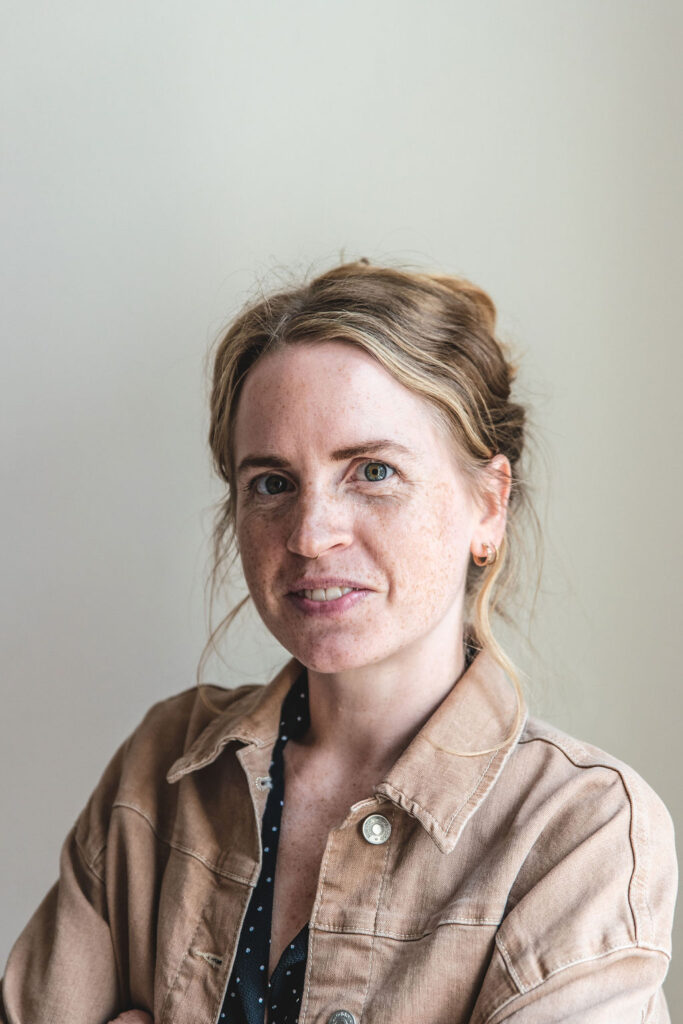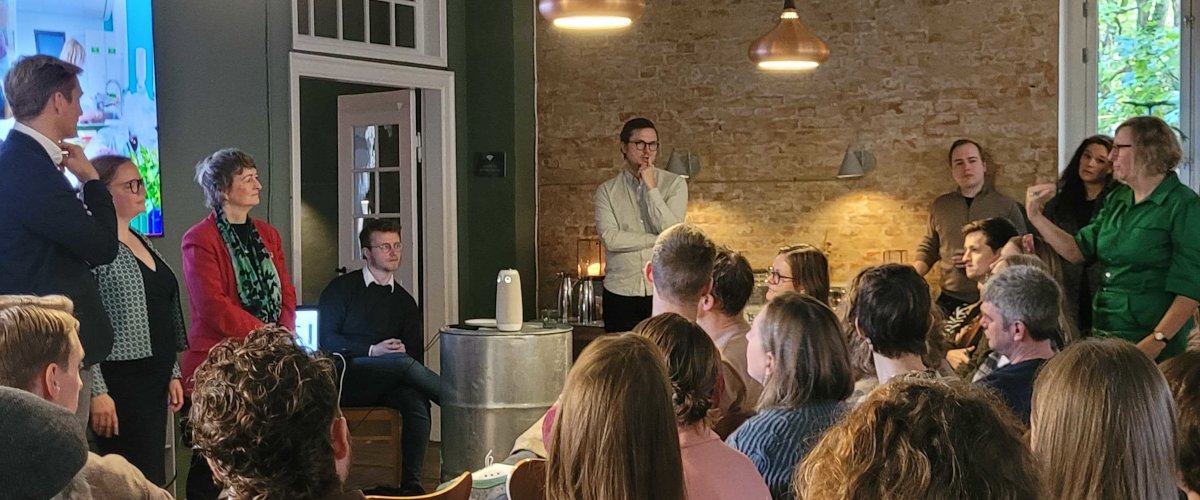
Line Barfod, Copenhagen’s mayor for technology and the environment, and Maja Højgaard, Brøndby’s new mayor, aren’t afraid to talk about how municipalities can influence residents’ eating habits. But this must be done in a positive way that benefits both the climate and citizens’ lives in a broad sense. They both described this at a well-attended Democracy X morning meeting on sustainable eating habits and “social tipping points.”
“I hope that the green transition will not only succeed in significantly reducing our carbon footprint, but also give us better lives, stronger communities, greater equality, and more nature—so that we can be happier.”
That’s what Line Barfod, Copenhagen’s mayor for technology and the environment, said this morning as she explained to the 150 participants at the Democracy x breakfast meeting how the city is working to encourage citizens to adopt more sustainable behaviors—including in relation to food and meals.
Line Barfod emphasized that the municipality itself must do everything it can to address climate issues directly. This means restructuring the city’s energy supply, transportation, and so on. But she also emphasized that, in her view, it is absolutely necessary to address citizens’ behavior, since it is largely our individual actions that have a significant climate impact both within and beyond the municipality’s borders. However, she said, this requires new methods and expertise within the municipality.
The mayor explained how the municipality, through its meal strategy, has reduced the carbon footprint of the 70,000 public meals served in nursing homes and daycare centers by 25 percent—a result that has exceeded the municipality’s own expectations. She also explained how the municipality is simultaneously working purposefully to influence residents’ behavior—through residents’ many community groups, local climate meetings in the city’s neighborhoods, and partnerships among food industry professionals, producers, supermarkets, restaurants, and others.
Maja Højgaard, mayor of Brøndby, spoke about how the Copenhagen suburb has, for several years, been working to ensure that residents who want to take action on climate change “come together so they can see and hear that they are not alone” —and how the municipality has built on the motivation residents already have and has supported their efforts to form and expand green neighborhood communities within the municipality.
“That way,” Maja Højgaard explained, “it will be ‘the residents themselves—you and me—who will be responsible for organizing community dinners, planting a new school forest, and much more.’”
In Brøndby, too, there is a recognition that the municipality needs different types of skills to engage citizens in a positive and inclusive way. Maja Højgaard says: “If we’re going to get people on board through their local communities, the municipality shouldn’t force it down people’s throats. According to the mayor of Vestegnen, the important thing is “to ask, ‘What do YOU want to do?’ And that’s not a way of working we’re used to in the rigid world of technical administration.”
At the morning meeting, Claus Meyer also shared his insights on why it is so important to change Danes’ eating habits and discussed his own ambitions to contribute to this effort, something he has been doing since the 1990s.
Claus Meyer emphasized that there is a great need for political support to change the Danes’ food culture —and that a good place to start would be for all public meals to “simply” comply with the government’s dietary guidelines , and perhaps even begin using public cafeterias as places where citizens can learn to cook good, healthier food from scratch. He also called on the government to lower the sales tax on vegetables and invest much more in food education for young people.
Following these various presentations, Democracy x Director Rune Baastrup gave a brief introduction to the concept of “social tipping points,” which is described in the new report that Democracy x is publishing today with support from the Novo Nordisk Foundation.
Rune Baastrup spoke, among other things, about the “neighborhood effect,” in which neighbors influence each other to adopt new behaviors—a phenomenon that has been clearly observed in Oslo, where the adoption of electric cars began in small local enclaves that grew larger and larger until eventually a “ketchupeffect,’ where electric cars now account for nearly all new cars in Norway. Rune Baastrup attributes this to the so-called ‘neighborhood effect,’ which the mayors also mentioned.
Rune Baastrup emphasized that it is NOT a matter of choosing between structural solutions to climate problems and citizen-driven behavioral changes: We absolutely must do both, but so far there has simply been far too little focus on how people’s behavior and norms are rooted in their local communities—and how they can be changed by working purposefully to promote new norms precisely through those communities. Because when citizens themselves are engaged in the green transition, it rubs off on their neighbors. In this way, by helping citizens get started, the municipality can support its political climate goals and green ambitions. This, in turn, holds politicians accountable for delivering on the green agenda.
Further Reading
Here is a brief guide to mobilizing citizens.
Read the full report on social hotspots.
Contact Us
If you have any questions or comments, or if you'd like to be invited to upcoming events or talk to us further, please feel free to contact us: